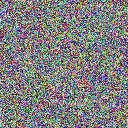
You probably didn't realize it, but the static noise visible on the home page of this website is not just noise. It's actually the entire script of the bee movie encoded with a technique called steganography.
The image is a lossless PNG with the RGB pixels encoding the bytes of a small payload:
- a magic header
- the original text size
- the compressed text size
- the zlib-compressed script
- padding to fill a square image
Additionally, before writing the bytes to pixels, the payload is XORed against a deterministic SHA-256 byte stream to ensure we have an evenly distributed pattern of noise.
Steganography
The term for this kind of idea is steganography, and is defined as the practice of hiding information inside another medium so that the carrier looks ordinary. In other words, cryptography tries to make a message unreadable, while steganography tries to make the message easy to miss.
Classic examples include hiding text in the least significant bits of an image, placing data in audio noise, or using metadata fields.
This version is especially uninteresting as the entire image is generated from the payload, but you could imagine the Bee Movie being hidden in other images with very little detection. Now that's interesting.
Hiding the Bee Movie in the Bee Movie
So let's do that too. Here's a regular bee image, converted to a lossless PNG, with the same Bee Movie script embedded into the least significant bits of its RGB channels:
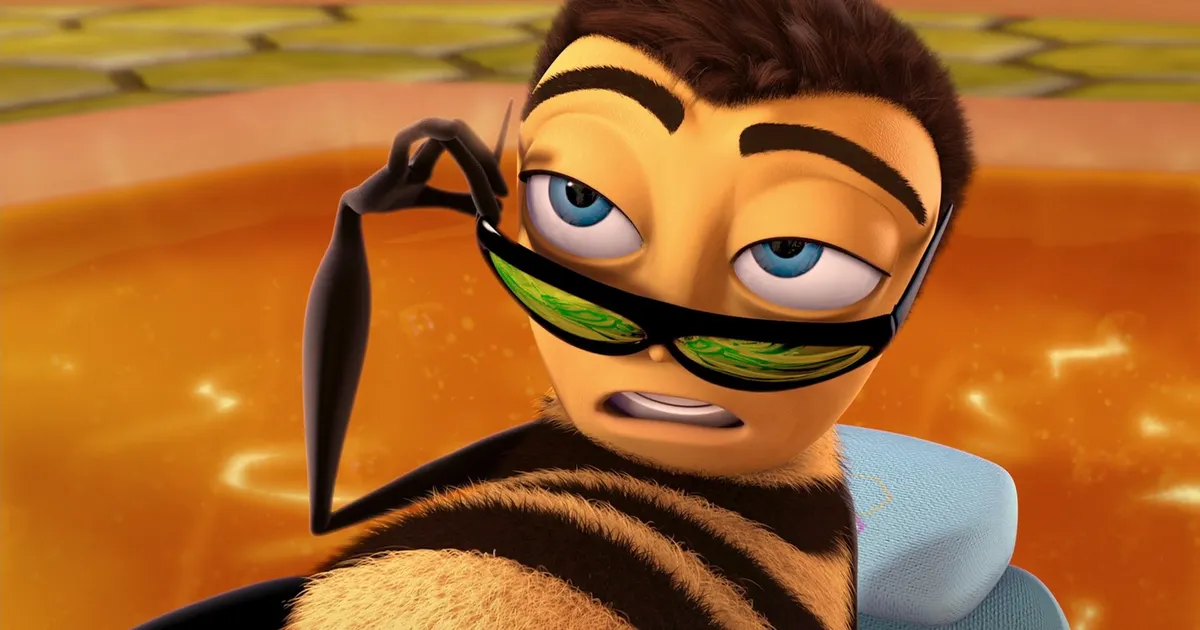
The image is still 1200x630, and the hidden payload is 20,557 bytes after compressing the 49,474-byte script and adding a small header. Since the payload only changes the lowest bit of each color channel, the image looks essentially unchanged, but the script can be recovered as long as the file remains lossless.
Encoder
Here's the encoder:
uv run encode.py script.txt noise.png# encode.py
import argparse
import binascii
import hashlib
import math
import struct
import zlib
from pathlib import Path
MAGIC = b"TXTIMG1\0"
PNG_SIGNATURE = b"\x89PNG\r\n\x1a\n"
XOR_SEED = b"txtimg1-static-noise-v1"
def xor_stream(data: bytes) -> bytes:
masked = bytearray(len(data))
cursor = 0
counter = 0
while cursor < len(data):
block = hashlib.sha256(XOR_SEED + struct.pack(">Q", counter)).digest()
take = min(len(block), len(data) - cursor)
for index in range(take):
masked[cursor + index] = data[cursor + index] ^ block[index]
cursor += take
counter += 1
return bytes(masked)
def png_chunk(chunk_type: bytes, data: bytes) -> bytes:
crc = binascii.crc32(chunk_type)
crc = binascii.crc32(data, crc) & 0xFFFFFFFF
return struct.pack(">I", len(data)) + chunk_type + data + struct.pack(">I", crc)
def write_rgb_png(path: Path, width: int, height: int, rgb: bytes) -> None:
row_size = width * 3
rows = [
b"\x00" + rgb[row_start : row_start + row_size]
for row_start in range(0, len(rgb), row_size)
]
ihdr = struct.pack(">IIBBBBB", width, height, 8, 2, 0, 0, 0)
png = (
PNG_SIGNATURE
+ png_chunk(b"IHDR", ihdr)
+ png_chunk(b"IDAT", zlib.compress(b"".join(rows), level=9))
+ png_chunk(b"IEND", b"")
)
path.write_bytes(png)
def next_power_of_two(value: int) -> int:
return 1 << (value - 1).bit_length()
def encode_text_to_png(input_txt: Path, output_png: Path) -> None:
raw = input_txt.read_bytes()
compressed = zlib.compress(raw, level=9)
payload = MAGIC + struct.pack(">QQ", len(raw), len(compressed)) + compressed
pixel_count = math.ceil(len(payload) / 3)
side = next_power_of_two(math.ceil(math.sqrt(pixel_count)))
capacity = side * side * 3
padded = payload + bytes(capacity - len(payload))
static = xor_stream(padded)
output_png.parent.mkdir(parents=True, exist_ok=True)
write_rgb_png(output_png, side, side, static)
print(f"Original: {len(raw):,} bytes")
print(f"Compressed: {len(compressed):,} bytes")
print(f"PNG size: {output_png.stat().st_size:,} bytes")
print(f"Image: {side}x{side}")
def main() -> None:
parser = argparse.ArgumentParser(
description="Encode a text file into a lossless static PNG image."
)
parser.add_argument("input_txt", type=Path, help="Path to the source text file.")
parser.add_argument("output_png", type=Path, help="Path for the generated PNG.")
args = parser.parse_args()
encode_text_to_png(args.input_txt, args.output_png)
if __name__ == "__main__":
main()The script writes a minimal RGB PNG directly with the PNG signature, IHDR, IDAT, and IEND chunks.
Decoder
And here's the decoder:
uv run decode.py noise.png decoded.txt# decode.py
import argparse
import hashlib
import struct
import zlib
from pathlib import Path
MAGIC = b"TXTIMG1\0"
PNG_SIGNATURE = b"\x89PNG\r\n\x1a\n"
XOR_SEED = b"txtimg1-static-noise-v1"
def xor_stream(data: bytes) -> bytes:
masked = bytearray(len(data))
cursor = 0
counter = 0
while cursor < len(data):
block = hashlib.sha256(XOR_SEED + struct.pack(">Q", counter)).digest()
take = min(len(block), len(data) - cursor)
for index in range(take):
masked[cursor + index] = data[cursor + index] ^ block[index]
cursor += take
counter += 1
return bytes(masked)
def paeth_predictor(left: int, above: int, upper_left: int) -> int:
predictor = left + above - upper_left
pa = abs(predictor - left)
pb = abs(predictor - above)
pc = abs(predictor - upper_left)
if pa <= pb and pa <= pc:
return left
if pb <= pc:
return above
return upper_left
def read_rgb_png(path: Path) -> bytes:
blob = path.read_bytes()
if not blob.startswith(PNG_SIGNATURE):
raise ValueError("Not a PNG file.")
offset = len(PNG_SIGNATURE)
width = height = bit_depth = color_type = interlace = None
idat_parts = []
while offset < len(blob):
length = struct.unpack(">I", blob[offset : offset + 4])[0]
chunk_type = blob[offset + 4 : offset + 8]
data_start = offset + 8
data_end = data_start + length
chunk_data = blob[data_start:data_end]
offset = data_end + 4
if chunk_type == b"IHDR":
width, height, bit_depth, color_type, _, _, interlace = struct.unpack(
">IIBBBBB", chunk_data
)
elif chunk_type == b"IDAT":
idat_parts.append(chunk_data)
elif chunk_type == b"IEND":
break
if (bit_depth, color_type, interlace) != (8, 2, 0):
raise ValueError("Only non-interlaced 8-bit RGB PNG files are supported.")
raw = zlib.decompress(b"".join(idat_parts))
bytes_per_pixel = 3
row_size = width * bytes_per_pixel
result = bytearray()
previous = bytearray(row_size)
cursor = 0
for _ in range(height):
filter_type = raw[cursor]
cursor += 1
row = bytearray(raw[cursor : cursor + row_size])
cursor += row_size
for index, value in enumerate(row):
left = row[index - bytes_per_pixel] if index >= bytes_per_pixel else 0
above = previous[index]
upper_left = previous[index - bytes_per_pixel] if index >= bytes_per_pixel else 0
if filter_type == 1:
row[index] = (value + left) & 0xFF
elif filter_type == 2:
row[index] = (value + above) & 0xFF
elif filter_type == 3:
row[index] = (value + ((left + above) // 2)) & 0xFF
elif filter_type == 4:
row[index] = (value + paeth_predictor(left, above, upper_left)) & 0xFF
elif filter_type != 0:
raise ValueError(f"Unsupported PNG filter type: {filter_type}.")
result.extend(row)
previous = row
return bytes(result)
def decode_png_to_text(input_png: Path, output_txt: Path) -> None:
data = xor_stream(read_rgb_png(input_png))
if data[:8] != MAGIC:
raise ValueError("Not a TXTIMG1 payload image.")
original_size, compressed_size = struct.unpack(">QQ", data[8:24])
compressed = data[24 : 24 + compressed_size]
raw = zlib.decompress(compressed)
if len(raw) != original_size:
raise ValueError(
f"Decoded size mismatch: expected {original_size}, got {len(raw)}."
)
output_txt.parent.mkdir(parents=True, exist_ok=True)
output_txt.write_bytes(raw)
print(f"Decoded {len(raw):,} bytes to {output_txt}")
def main() -> None:
parser = argparse.ArgumentParser(
description="Decode a TXTIMG1 PNG image back into a text file."
)
parser.add_argument("input_png", type=Path, help="Path to the encoded PNG.")
parser.add_argument("output_txt", type=Path, help="Path for the decoded text file.")
args = parser.parse_args()
decode_png_to_text(args.input_png, args.output_txt)
if __name__ == "__main__":
main()Don't believe me?
First, download the image:
curl -fsSL https://cmpadden.github.io/images/noise.png -o noise.pngSave the decode.py snippet, and then run the following:
$ uv run decode.py noise.png out.txt && head -n10 out.txt
Decoded 49,474 bytes to out.txt
According to all known laws of aviation, there is no way a bee should be able to fly.
Its wings are too small to get its fat little body off the ground.
The bee, of course, flies anyway because bees don't care what humans think is impossible.
Yellow, black. Yellow, black. Yellow, black. Yellow, black.
Ooh, black and yellow!
Let's shake it up a little.
Barry! Breakfast is ready!
Coming!
Hang on a second.
Hello?
To hide your own text file inside of a noisy image, save encode.py and then run:
uv run encode.py my-super-secret-text.txt noise.png